_DRAFT DAY_p1_v2
A social by:
10/11/2023
17:00 – 21:00
RESOLVE Studio/ Little Turf
39 Keeley Road
Croydon, CR0 1TF
OPEN TO ALL NO TICKET NEEDED
“Black insurgent pencil-work – that the people who do this work reach for pencils because it’s always the first draft. We’re always drafting. Always in rehearsal.”
– Farzana Khan, inspired by Amahra Spence, ‘Life-Affirming Infrastructures’
Developed during a week-long peer-to-peer knowledge exchange in Sheffield called ‘Nurturing Ecologies’ and inspired by words of Farzana Khan and Amahra Spence, _DRAFT DAY is an exercise that examines one critical question: what are the necessary spaces, programmes, and resources to facilitate
radical infrastructural work?
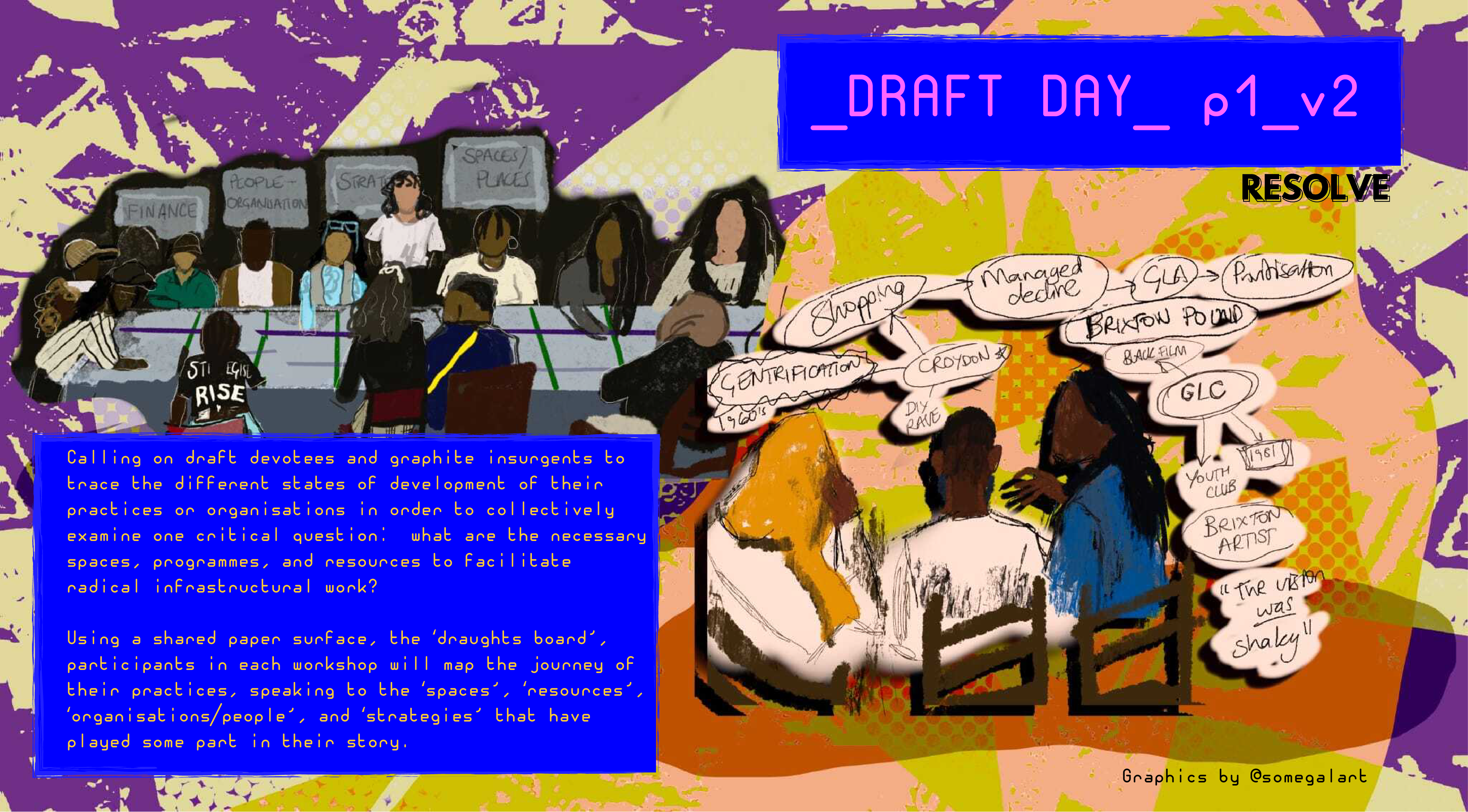
For _DRAFT DAY_p1_v2, we are calling once again on draft devotees and graphite insurgents to trace the different states of development of their practices or organisations. Using a shared paper surface, the ‘draughts board’, participants in each workshop will map the journey of their practices, speaking to the ‘spaces’, ‘resources’, ‘organisations/people’, and ‘strategies’ that have played some part in their story. This draws from the work of Maurice Mitchell, the national director of the Working Families Party, who in his article, Building Resilient Organisations, highlights a number of systemic challenges faced in building resilient social justice organisations and key strategic areas for sustainable solutions.
This exercise builds towards a prospective ‘Part 2’, in which we draw from our journeys to collectively imagine what is possible for facilitating radical infrastructural work. In the meantime, ‘Part 1’ allows us to contribute to the foundations of a future-facing strategy that determines conditions for sustainability and tools for organisational resilience.


